
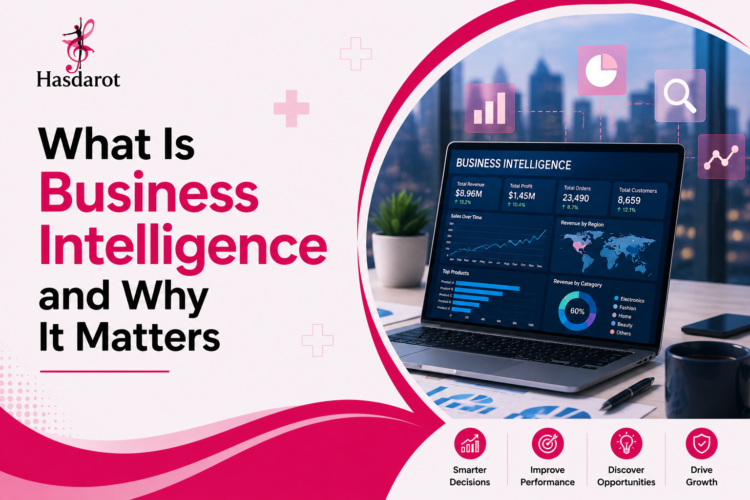
Businesses generate enormous amounts of data every day through sales transactions, customer interactions, websites, marketing campaigns, financial systems, and operational activities. However, collecting information alone does not create value. Companies need a reliable way to organize, analyze, and interpret that information before it can support meaningful decisions. This is where Business Intelligence (BI) becomes important.
Business Intelligence combines technologies, processes, and analytical methods that transform raw business data into useful insights. Through data analytics, interactive dashboards, reporting systems, and performance monitoring, organizations can understand what is happening within their business and determine where improvements are needed.
From identifying sales trends to measuring operational performance, BI gives decision makers greater visibility into their organization. Instead of depending entirely on assumptions, companies can use evidence to plan strategies, allocate resources, and respond to changing market conditions.
What Is Business Intelligence?
Business Intelligence refers to the technologies and practices businesses use to collect, integrate, analyze, and visualize organizational data. Its primary purpose is to make complex information easier to understand and use for data-driven decision making.
Business Intelligence typically brings information together from different sources, such as customer relationship management systems, accounting software, websites, enterprise resource planning platforms, and sales databases. The information can then be presented through BI dashboards, charts, reports, and other visual formats.
For example, a sales manager may use a Business Intelligence dashboard to monitor monthly revenue, compare regional performance, identify top-selling products, and determine whether the team is meeting its targets. Instead of reviewing several spreadsheets independently, the manager receives important information through one centralized reporting environment.
This ability to turn scattered information into structured insights makes business data analysis valuable across departments.
How Does Business Intelligence Work?
Business Intelligence works by moving information through several stages, from data collection to visualization and decision making. Although the technology can vary between organizations, the basic process follows a similar structure.
Data Collection
The process begins with gathering information from relevant business systems. These sources may include:
- CRM and sales platforms
- Accounting and financial software
- Websites and digital marketing platforms
- ERP and inventory management systems
- Customer service platforms
- Internal databases and spreadsheets
Combining information from multiple sources creates a more complete picture of business performance.
Data Integration and Preparation
Business information often exists in different formats and systems. Before meaningful analysis can take place, the data must be cleaned, standardized, and combined.
Processes such as data integration and ETL (Extract, Transform, Load) help organizations prepare information for analysis. Errors, duplicate records, and inconsistent formats can be addressed during this stage.
The prepared information may then be stored in a data warehouse, data lake, or another centralized environment.
Data Analysis
Once information is organized, analytical techniques can be used to identify patterns, relationships, and trends. Companies can compare historical performance, examine customer behavior, track costs, and evaluate business processes.
Modern Business Intelligence tools can process large datasets and make analysis more accessible to managers and other business users.
Data Visualization and Reporting
Analyzed information becomes much easier to interpret when presented visually. Data visualization converts complex datasets into charts, graphs, scorecards, maps, and dashboards.
Rather than reading thousands of rows of information, decision makers can quickly identify important trends through visual reports.
Why Is Business Intelligence Important?
The importance of Business Intelligence comes from its ability to provide organizations with clearer and more timely information. Business environments change quickly, and relying on outdated reports can make it difficult to respond effectively.
A well-designed BI solution gives companies better visibility into their operations. Leaders can monitor key performance indicators (KPIs), identify underperforming areas, and compare actual results against established goals.
Business Intelligence can also reduce uncertainty. Decisions are still influenced by experience and judgment, but BI provides evidence that helps validate those decisions.
For example, a retailer considering opening a new location could analyze customer demographics, regional sales, purchasing patterns, and existing store performance before making the investment.
This creates a more structured approach to strategic decision making.
Key Benefits of Business Intelligence
Organizations adopt Business Intelligence for different reasons, but several advantages apply across industries.
Better Decision Making
One of the main benefits of Business Intelligence is improved access to reliable information. Managers can evaluate actual performance instead of making decisions based solely on assumptions.
When important metrics are available through centralized dashboards, teams can identify issues and opportunities more quickly.
Improved Operational Efficiency
BI can reveal inefficient processes that may otherwise remain unnoticed. Businesses can monitor production times, employee productivity, inventory levels, service performance, and operating costs.
Through operational analytics, companies can determine where resources are being wasted and where workflows could be improved.
Greater Understanding of Customers
Customer information is one of the most valuable sources of business insight. Business Intelligence can help organizations analyze purchasing history, customer preferences, engagement, retention, and other behavioral patterns.
Using customer analytics, businesses can identify valuable customer segments and better understand what influences purchasing decisions.
These insights can support marketing, sales, product development, and customer service strategies.
More Accurate Performance Tracking
Organizations need measurable indicators to determine whether their strategies are working. Business performance management supported by BI makes it possible to continuously monitor important metrics.
Executives may track revenue growth and profitability, while marketing teams monitor conversion rates and customer acquisition costs. Sales teams can analyze pipeline value, win rates, and average deal size.
Having clearly defined metrics creates greater accountability across departments.
Business Intelligence Tools and Technologies
Modern Business Intelligence depends heavily on technology. BI software allows organizations to analyze information without manually processing every dataset.
Popular platforms commonly provide features such as interactive dashboards, automated reporting, visual analytics, data modeling, and integration with multiple business systems.
The right Business Intelligence platform depends on the organization’s size, data infrastructure, reporting requirements, technical capabilities, and budget.
Self-service BI has also become increasingly important. Self-service Business Intelligence allows non-technical employees to explore information and create reports without depending on a technical team for every request.
This can make insights more accessible throughout an organization while reducing delays in reporting.
Business Intelligence vs. Business Analytics
Business Intelligence and business analytics are closely related, but they are not always identical.
Business Intelligence traditionally focuses on understanding current and historical performance. It helps answer questions such as:
What happened?
Where did it happen?
How is the company performing?
Business analytics can go further by using statistical methods and models to understand why something happened and what may happen next.
For example, a BI report might show that product sales decreased by 15 percent during a particular quarter. Business analytics may investigate the factors behind that decline and build models to estimate future demand.
Organizations often use both approaches together to develop a more complete data analytics strategy.
Business Intelligence and Predictive Analytics
Traditional BI largely focuses on historical and current information, but modern systems increasingly incorporate predictive analytics.
Predictive models use historical patterns and statistical techniques to estimate possible future outcomes. Businesses may use these capabilities for sales forecasting, inventory planning, customer churn prediction, or financial risk assessment.
For instance, an ecommerce company could analyze previous purchasing behavior to estimate which customers are most likely to make another purchase.
While predictive analysis cannot guarantee future outcomes, it can help businesses prepare for likely scenarios and make more informed plans.
How BI Supports Different Business Departments
Business Intelligence is not limited to executive reporting. Different departments can use BI according to their specific goals.
Sales teams can use sales analytics to monitor pipelines, conversion rates, sales targets, and customer activity. Marketing teams can measure campaign performance, traffic sources, leads, conversions, and return on marketing investment.
Finance departments can use financial analytics for revenue analysis, budgeting, forecasting, expense tracking, and profitability monitoring.
Operations teams can monitor inventory, supply chains, productivity, fulfillment times, and resource utilization.
Human resources departments can also use workforce analytics to understand recruitment trends, staffing requirements, employee turnover, and organizational performance.
Because BI connects information across departments, leadership can gain a broader understanding of overall organizational performance.
Role of Data Warehousing in Business Intelligence
A data warehouse is an important part of many Business Intelligence environments. It acts as a centralized repository where information from different business systems can be stored and organized for reporting and analysis.
Without centralized data management, departments may rely on separate spreadsheets or databases. This can create inconsistent reports and conflicting versions of the same information.
A structured data warehousing solution helps establish a more reliable source of business information. It can also improve reporting speed because analytical systems do not need to retrieve information separately from multiple operational platforms every time a report is generated.
Business Intelligence Challenges
Although BI offers significant advantages, successful implementation requires careful planning.
Poor data quality is one of the biggest challenges. Inaccurate, incomplete, or duplicate information can produce misleading insights. Businesses therefore need strong data governance and quality-control processes.
Another challenge is selecting relevant metrics. Creating hundreds of dashboards does not automatically improve decision making. Organizations need to identify KPIs that genuinely reflect their objectives.
User adoption can also affect success. If dashboards are difficult to understand or employees are not trained to use them, even sophisticated BI systems may provide limited value.
Security is equally important because Business Intelligence environments can contain sensitive financial, operational, employee, and customer information. Appropriate data security and access controls should therefore be part of any BI strategy.
How to Implement a Business Intelligence Strategy
A successful Business Intelligence strategy should begin with clearly defined business objectives rather than technology alone.
Organizations should first determine which problems they want BI to solve. These could include improving sales forecasting, reducing operating expenses, understanding customer behavior, or creating more accurate executive reporting.
Next, businesses should identify the required data sources and assess the quality of existing information. Appropriate BI technology can then be selected based on organizational requirements.
Dashboards should focus on meaningful KPIs and provide information that users can easily interpret. Employees should also receive appropriate training so that Business Intelligence becomes part of everyday decision making rather than simply another reporting tool.
Finally, the system should be continuously evaluated. As business priorities change, dashboards, metrics, and data models may also need to evolve.
Future of Business Intelligence
The future of Business Intelligence is closely connected with artificial intelligence, automation, cloud computing, and advanced analytics.
AI-powered systems are making it easier to identify patterns in large datasets, while machine learning can support forecasting and predictive modeling. Natural language technologies are also allowing users to interact with data using everyday questions rather than complex queries.
Cloud Business Intelligence is another important development because it allows companies to access analytical platforms without maintaining all infrastructure internally.
Real-time analytics will continue to become more important as organizations seek faster information about customers, operations, and market conditions. Rather than waiting for monthly reports, businesses can increasingly monitor important changes as they occur.
Conclusion
Business Intelligence provides organizations with a structured way to transform large volumes of information into useful, actionable insights. By combining data collection, data integration, business analytics, BI dashboards, and data visualization, companies can gain a clearer understanding of their performance.
Effective BI can support smarter decisions, better customer understanding, improved operational efficiency, accurate forecasting, and stronger strategic planning. As businesses continue to generate more information, the ability to turn that data into meaningful intelligence will become increasingly important for sustainable growth and competitive performance.
Frequently Asked Questions
What is Business Intelligence in simple terms?
Business Intelligence is the process of collecting and analyzing business data to help organizations understand performance and make better decisions. BI systems usually present information through dashboards, charts, reports, and other visual tools.
What are the main components of Business Intelligence?
Common components include data sources, data integration, ETL processes, data warehouses, analytics tools, reporting systems, dashboards, and data visualization technologies.
What is an example of Business Intelligence?
A company using a dashboard to monitor sales revenue, customer acquisition, regional performance, inventory levels, and profitability is a common example of Business Intelligence.
How does Business Intelligence improve decision making?
BI provides decision makers with organized and measurable information about business performance. This helps them identify trends, compare results, discover problems, and evaluate opportunities before making important decisions.
Is Business Intelligence the same as data analytics?
They overlap but are not exactly the same. Business Intelligence generally emphasizes reporting and understanding current or historical business performance, while data analytics can include deeper statistical, predictive, and exploratory analysis.